Otterbein's Game-Day Rulebook Was Written by a Church, Not the City
September 24, 2026
September 24, 2026
By 9 a.m. on Sunday, September 20, cars with Pennsylvania and Delaware plates were already parked along Hanover Street, four hours before the Ravens kicked off against New Orleans. Nobody had told them to arrive early. Nobody needed to. Anyone who has lived in Otterbein through a football season knows the neighborhood runs on two separate clocks, and on Sundays like that one, the visiting clock wins.
What's easy to miss, even if you've lived here for years, is that the system managing all of it wasn't built by the city or the Ravens. It was built by a 250-year-old church and a parking district drawn up decades before anyone imagined M&T Bank Stadium would sit three blocks from Otterbein's front stoops.
Old Otterbein United Methodist Church has stood at Sharp and Conway streets for more than 250 years, which makes it older than the interstate interchange that nearly erased this neighborhood in the 1970s and older than every rowhouse around it. On Sundays when the Ravens play, it also runs one of the more disciplined parking operations in South Baltimore, and the rules are stricter than anything posted on a city sign.
Current parkers get first right of renewal for the following season. Anyone new has to call the church office starting in April and wait to see if a spot opens. No tailgating, no alcohol, no smoking, and every car has to be gone within thirty minutes of the final whistle. It reads less like an overflow lot and more like a private club with a very specific admission process, which in a neighborhood this small is exactly the point. A church lot that fills up in an orderly fashion is one less block of residents circling for a spot that used to be theirs before kickoff.
That discipline matters because Otterbein's own residential parking program has no such flexibility built in. The entire neighborhood is designated Permit Parking Area 8 under the city's Residential Parking Permit Program, which means every car parked on the street needs a visible decal, and every guest needs a paper pass handed over by the resident they're visiting. It's a system built for a quiet Tuesday, not for eight Sundays and a Thursday and a Monday night when the neighborhood's population effectively doubles for six hours. The permit program was never going to absorb game-day volume on its own. The church lot is the pressure valve nobody advertises.
The Ravens play eight home games at M&T Bank Stadium this season, and the calendar is specific enough that residents can plan around it rather than get surprised by it.
| Date | Opponent | Time |
|---|---|---|
| Sept. 20 (already played) | New Orleans Saints | 1:00 p.m. |
| Oct. 4 | Tennessee Titans | 1:00 p.m. |
| Oct. 25 | Cincinnati Bengals | 1:00 p.m. |
| Nov. 5 | Jacksonville Jaguars | 8:15 p.m. (Thursday) |
| Nov. 16 | Los Angeles Chargers | 8:15 p.m. (Monday) |
| Dec. 13 | Tampa Bay Buccaneers | 1:00 p.m. |
The season closes with four straight AFC North matchups in December and January, the first time Baltimore has finished a regular season that way since the league's 2002 realignment, though the exact home dates for those late games were still to be determined as of this writing. What the table above doesn't show is the other event that already tested the neighborhood this fall. On September 12, M&T Bank Stadium hosted New Zealand and South Africa in a rugby test that drew 68,173 fans, the largest crowd ever recorded for a rugby match in the United States. Otterbein absorbed that Saturday the same way it absorbs a Ravens Sunday: quietly, and mostly without complaint, because the streets are built to handle exactly this kind of temporary flood and then let it recede.
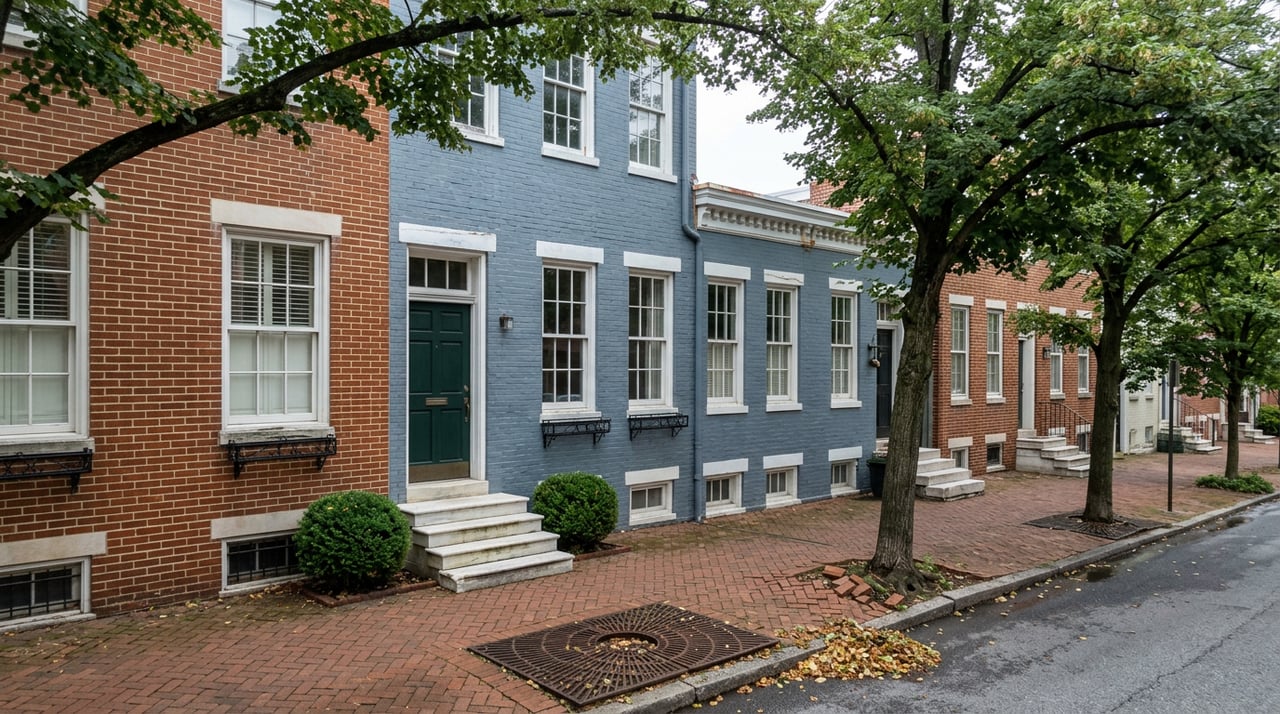
There's a detail about Otterbein that outside visitors have figured out faster than most people expect. Walking through the neighborhood on the way to the stadium is quieter and often faster than cutting through Federal Hill, precisely because Otterbein has almost no bars or restaurants along the way. That absence, which can feel like a gap if you're new here, turns out to be the neighborhood's advantage on game day. Fans headed to M&T Bank Stadium use Otterbein's tree-lined blocks as a shortcut, walking past porches and pocket parks instead of squeezing through a crowd outside a sports bar.
That means on a Sunday afternoon, the resident walking their dog past Wheel Park might pass more strangers than usual, cutting through on their way to the game rather than lingering. It's a strange kind of foot traffic. It comes in waves timed to kickoff and the final whistle, and it disappears just as fast.
None of this is what Otterbein feels like most of the year. The same seven small park areas maintained by the Otterbein Community Association and the Harbor Walk Townhouse Association, including Wheel Park, Concert Park, and Hill Street Park, spend the vast majority of their time being exactly what they were designed for: places to sit on a bench, let a dog off the leash for a stretch, or let a kid burn off energy between two rows of brick townhouses. Concert Park earns its name on plenty of weekends that have nothing to do with football, hosting neighborhood barbecues and informal concerts that draw exactly the kind of crowd the park was built for, which is to say, people who already live here.
Morning Mugs Coffee on Hughes Street has been the neighborhood's actual daily anchor since 2021, long before any given Sunday's opponent gets decided by the NFL schedule-makers. A few blocks north, Ramen Utsuke pulls in residents looking for something other than the usual pregame fare. And in the warmer months, before football season resets the neighborhood's rhythm entirely, the Otterbein Swim Club runs First Friday Late Swims and movie nights that have nothing to do with any team's win-loss record.
James Baldwin, who has lived in Otterbein for more than two decades, puts it simply: the parks are what actually hold the neighborhood together, more than any single business or event. Otterbein doesn't have many commercial storefronts of its own, which is part of what makes it feel more residential than the neighborhoods around it. People walk to Federal Hill or the Inner Harbor for dinner, then come home to streets quiet enough that a pocket park can double as a living room.
What makes Otterbein interesting isn't that it sits next to a 71,000-seat stadium. Plenty of neighborhoods do that and lose their character to it. What makes Otterbein interesting is that it built its own systems to keep that from happening, a church that manages its own overflow with more discipline than the city's own permit program, a walking route that quietly absorbs visitor traffic without a single new business opening to serve it, and a set of pocket parks that snap back to being dog-walking cut-throughs the moment the crowd clears out. The neighborhood doesn't need eight Sundays a year to define it. It just needs to survive them well, which by every account it continues to do.
If you're already living on one of these blocks, you know this rhythm better than any outsider could describe it. If you're the kind of person who reads a piece like this and starts wondering what a rowhome on one of these quiet streets is actually worth, or what it takes to buy into a neighborhood with a parking system this particular, the team at The Baldwin & Griffin Group of Compass has spent years inside these blocks and is glad to talk through what that looks like. Get in touch whenever the timing is right.
Stay up to date on the latest real estate trends.